Why a Privacy-First Mobile Wallet Matters: A case-led look at Monero, Bitcoin, and multi-currency mobile custody
Surprising but true: most mobile wallets leak useful metadata even when the private keys stay on your phone. That leak — IP addresses, predictable change addresses, or cross-chain routing fingerprints — is the vector that often defeats otherwise strong cryptographic privacy. For privacy-minded users in the US weighing Monero, Bitcoin, and multi-asset wallets, the difference between “non-custodial” and “private” is practical: one keeps coins in your control, the other limits what outsiders can infer about who you are and what you do.
This article uses a concrete case — a privacy-conscious U.S. user who wants to hold XMR, BTC, LTC, and some ERC‑20 tokens on a single mobile device — to explain mechanisms (how privacy features work), trade-offs (where protections cost convenience or compatibility), and limits (what remains exposed unless you change behavior or infrastructure). Along the way I correct common misconceptions about mobile privacy wallets and give decision-useful heuristics you can apply to select and operate a wallet safely.
Case: a privacy-first user in the US — goals and constraints
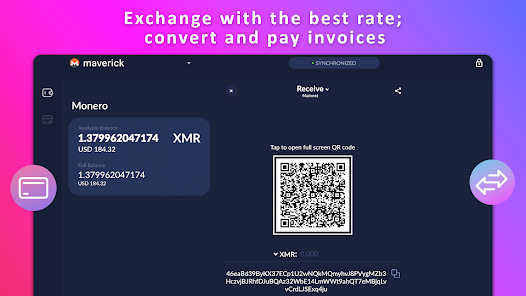
Meet the scenario: a U.S.-based privacy-oriented individual who needs one mobile wallet to store Monero (XMR) for sensitive payments, Bitcoin (BTC) for broader acceptance, Litecoin (LTC) with optional MWEB privacy, and some ERC‑20 tokens for occasional trading. Their non-negotiables: control of private keys (non-custodial), minimal telemetry, ability to use network-level anonymity (Tor/I2P), and support for hardware-device anchoring when possible. They also want in-app swaps without trusting a centralized exchange for every trade.
Mapping those requirements to concrete mechanisms shows why design matters. Non-custodial architecture keeps the seed phrase on the device; device-level encryption like Secure Enclave on iOS or TPM on Android prevents easy extraction if the phone is lost. But non-custodial does not automatically protect network metadata — that’s where Tor-only modes, I2P proxies, and custom node options become essential. The wallet in this case supports those network privacy features, plus Monero subaddresses and background sync, Bitcoin privacy primitives like PayJoin v2 and Silent Payments, and optional Litecoin MWEB. Those are precisely the layers that matter to a user trying to avoid deanonymization beyond cryptographic key control.
Mechanisms explained: how privacy features stack and where they break
Start with the basics: key custody and device security. Device-level hardware security (Secure Enclave / TPM) encrypts private keys and restricts access to local PIN/biometric unlock. This is necessary but not sufficient: if your wallet sends transaction data over the network using a default public node, observers can correlate your IP with transactions. That’s why a Tor-only mode, I2P proxy support, or the ability to run/connect to custom nodes is the next critical layer. Those features reduce the risk that your device’s network traffic betrays on-chain activity.
Monero-specific protections operate differently because Monero’s protocol already conceals amounts and recipients cryptographically. Subaddresses are a simple but powerful tool: they let a single wallet generate many receiving addresses so that external observers cannot trivially link multiple payments to one account. The wallet keeps the private view key on the device and supports background sync, which reduces the need to query third-party nodes repeatedly — another metadata leak vector. But note the limitation: while subaddresses and private view key control minimize some links, endpoint-level compromises (malicious relay nodes, or revealing the view key to a service) can still expose balances or flows.
For Bitcoin, privacy is fundamentally different because BTC transactions are public by default. Practical privacy here comes from transaction construction and wallet behavior: Silent Payments (privacy-preserving invoice-like flows), PayJoin v2 (cooperative transactions that hide which output is change), UTXO coin control (manual selection of unspent outputs), and batching (fewer transactions, less on-chain footprint). These features reduce heuristics adversaries use to cluster addresses, but they don’t change the fundamental public ledger. Also, hardware wallet integration (Ledger, or air-gapped Cupcake) adds a layer of protection against malware that might try to extract keys or sign malicious transactions; that is an important trade-off for users who juggle convenience and threat models.
Correcting common myths: what privacy wallets actually do (and do not) guarantee
Myth: Open-source and zero-telemetry equals perfect privacy. Reality: Open-source code and strict no-telemetry are strong indicators — they let independent reviewers confirm the absence of hidden telemetry and verify key handling — but they do not eliminate all operational leaks. Network routing, user behavior, and external services (exchanges, merchant payees) all create metadata that is outside an app’s code. The wallet’s Tor/I2P support and custom node options mitigate some of those risks, but not all.
Myth: One wallet can make all coins equally private. Reality: Different blockchains provide different primitives. Monero yields stronger default privacy at the protocol level; Zcash requires shielded usage to reach parity and Cake Wallet enforces mandatory shielding for outbound ZEC which prevents accidental transparent leaks. Litecoin’s MWEB is optional and can be activated for privacy, but not every counterparty accepts MWEB outputs. Bitcoin needs careful transaction construction and may still leak linkable metadata even with PayJoin and batching. As a user, you need to adapt behavior per chain: use subaddresses on XMR, shield ZEC, opt into MWEB when practical, and use PayJoin/coin-control for BTC.
Operational trade-offs: convenience, compatibility, and risk
Convenience often conflicts with privacy. Built-in swapping is extremely convenient — and this wallet offers instant swaps across assets using decentralized routing via NEAR Intents — but swaps introduce new trust and privacy considerations. Decentralized routing that aggregates market makers can reduce reliance on centralized custodians, yet the swap path itself may reveal counterparties or require on-chain actions that create linkable footprints. If maximum privacy is the priority, splitting the tasks — using separate, privacy-focused channels for large sensitive transfers and using swaps for routine portfolio adjustments — is a sensible heuristic.
Compatibility is another constraint. Hardware wallets increase security substantially, but not all hardware supports every privacy feature (for example, some hardware integrations may limit how a wallet constructs non-standard transactions like MWEB or PayJoin). The air-gapped Cupcake approach reduces attack surface but requires operational discipline: secure paper backup of seed phrases, careful firmware management, and an acceptance of slower workflows. In short: choose the features you need and accept that some combinations raise friction.
Decision framework: picking and operating a privacy mobile wallet
Here is a compact heuristic to decide whether a specific wallet and configuration fit your needs:
1) Threat model first: Are you protecting against casual chain analytics, or targeted deanonymization by sophisticated actors? For sophisticated threats, prioritize hardware isolation, Tor/I2P, and chain-specific privacy features. For casual threats, device-level encryption and good operational hygiene may suffice.
2) Chain-specific rules: For XMR use subaddresses and keep view keys local. For ZEC always use shielded addresses when possible (the wallet enforces this by default). For BTC enable PayJoin v2 and manual UTXO control if you care about on-chain linkability. For LTC consider activating MWEB if your counterparties and services support it.
3) Network hygiene: Use Tor-only mode or I2P if you need strong IP anonymity. If you must use a public Wi‑Fi, prefer a VPN to reduce trivial IP exposure and combine it with Tor; but understand VPNs add a third party that sees your IP endpoints.
4) Backup and migration: Keep your seed phrase offline and test recovery on another device. Be aware of known migration limits — for example, Zashi ZEC seed phrases are incompatible and require manual transfers to a newly created wallet — and plan transfers accordingly.
5) Choose swaps carefully: Use in-wallet swaps for low-sensitivity trades; for privacy-critical transfers consider atomic swaps or on-chain mixing strategies that you control.
What to watch next: signals and conditional scenarios
Three signals matter going forward. First, wider adoption of PayJoin v2, Silent Payments, and MWEB by exchanges and merchants would materially raise the baseline privacy available to BTC and LTC users. Second, any changes in mobile OS security (for example, new restrictions on background processes or changes to Secure Enclave APIs) could alter device-level guarantees and should prompt wallet updates. Third, regulatory pressure on privacy-preserving services may increase operational friction: watch whether marketplaces or fiat on/off ramps refuse shielded or MWEB outputs. Each of these would change the practical trade-offs for U.S. users and should be monitored.
Conditionally: if exchanges and custodial services begin to accept shielded ZEC and MWEB LTC as standard, the cost of privacy will fall. Conversely, if wallet-level telemetry requirements are imposed by app stores, the practical ability to run no-telemetry wallets could be reduced; that would increase the value of open-source, side-loaded, or direct-APK distribution channels.
Practical next steps for the privacy-minded mobile user
Start by matching your threat model to features: if IP-level linkability matters, enable Tor-only mode and avoid default public nodes. If you hold Monero, use subaddresses and confirm the private view key never leaves your device. Use hardware wallets for large balances or high-risk profiles; pair them with the wallet’s air-gapped or Ledger support. When using in-app swaps, prefer decentralized, routed options to limit single points of failure — but understand they still create on-chain footprints. Finally, test recovery and understand cross-wallet migration limits (notably the ZEC Zashi incompatibility) before relying on any single path for long-term access.
If you want to experiment with a wallet that implements these layered privacy and multi-currency features, the vendor offers multi-platform builds and direct distribution channels; you can find the official download from the developer here: cake wallet download.
FAQ
Q: If my wallet is open-source and non-custodial, do I still need Tor or I2P?
A: Yes. Open-source and non-custodial mean you control keys and the code can be audited, but they do not hide network metadata. Tor or I2P or connecting to a custom node is needed to reduce IP-level correlations between you and on-chain activity.
Q: Does Monero eliminate the need for network anonymity?
A: Monero provides strong on-chain privacy (concealed amounts and recipient data), but network-layer metadata can still link transactions to an IP. For the strongest anonymity, use Monero with Tor or a private node. Background synchronization and keeping the view key local reduce exposure but do not replace network privacy tools.
Q: Are in-app swaps safe for privacy-sensitive transfers?
A: In-app swaps using decentralized routing reduce reliance on central custodians but are not a panacea. They may still create linkable on-chain actions; for highly sensitive transfers, consider breaking transfers into stages, using privacy-preserving chains for settlement, or using exchange methods that minimize traceable on-chain links.
Q: What is the biggest operational mistake privacy users make?
A: Treating software features as a substitute for operational discipline. Examples: reusing addresses across chains, sharing view keys, using public Wi‑Fi without network protections, or relying on custodial exchanges for shielded withdrawals. Privacy is a layered practice: toolset plus behavior.